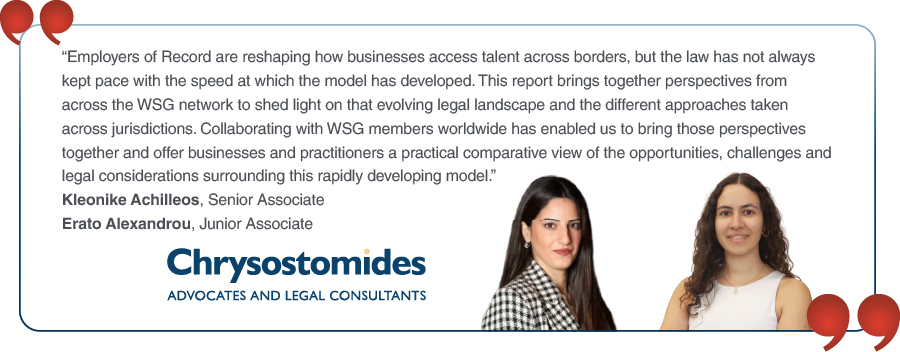
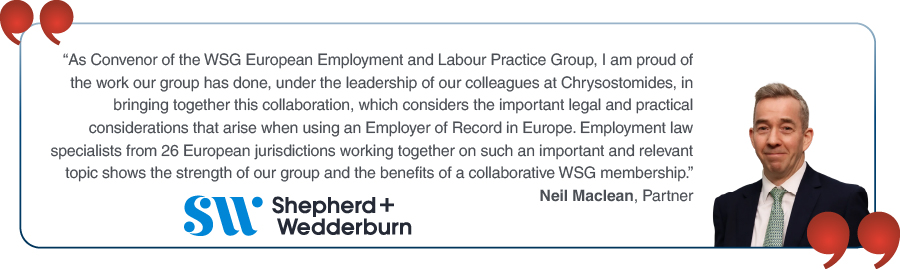
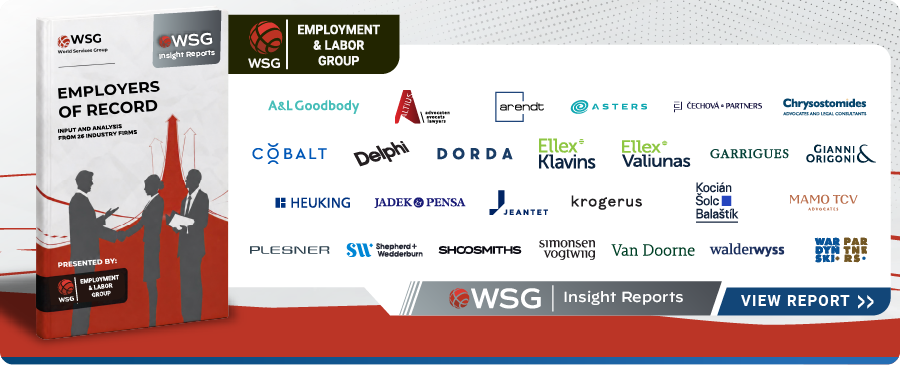
This comprehensive publication brings together insights from WSG employment law specialists across 26 European jurisdictions to examine the legal and practical considerations surrounding Employers of Record (EoRs). The report provides a comparative analysis of how EoR arrangements are treated under local law and explores employment, labor, tax, and social security considerations that organizations should assess when implementing cross-border workforce strategies.
Access the report:
Employers of Record: Input and Analysis from 26 Industry Firms (digital version and printable version available).
Read More
5bd9d174-c6ae-4d01-b83d-f8a40c352543|0|.0|27604f05-86ad-47ef-9e05-950bb762570c
WSG member Rodrigo, a leading law firm in Peru, marked a historic milestone with the promotion of Mayra Jiménez as the firm's first female Litigation Partner, reflecting the firm's ongoing commitment to strengthening leadership and fostering diverse partnerships. Alongside this landmark appointment, Rodrigo also promoted four additional lawyers to partner, supporting the firm's continued growth and increasing client demand across its Litigation, Arbitration, Tax, and Data Protection practices.
Read More

edada9cf-7c0c-4472-967c-7d60b82e4ead|0|.0|27604f05-86ad-47ef-9e05-950bb762570c
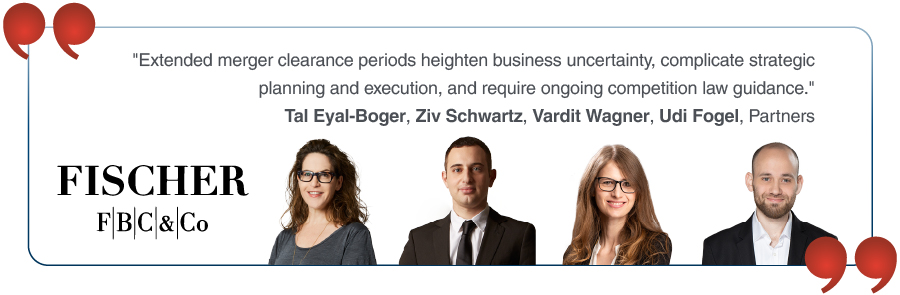
In this Global Competition Review article, WSG members Tal Eyal-Boger, Ziv Schwartz, Vardit Wagner and Udi Fogel, Partners at Fischer (FBC & Co.) discuss the evolving landscape of Israeli competition law and the Israel Competition Authority's proactive enforcement strategy. With recent legislative and regulatory developments, evolving merger review practices and increased regulatory focus on anticompetitive conduct, they highlight trends that reflect broader global competition enforcement priorities, offering insight for businesses and legal professionals navigating cross-border transactions and compliance in an increasingly complex antitrust environment.
Read More
3daa5681-5fae-4c50-add5-07dbf3fe5e2b|0|.0|27604f05-86ad-47ef-9e05-950bb762570c
WSG member Shoosmiths has joined The 49 Collective, a cross-industry initiative dedicated to improving the representation and progression of women across the electric mobility and clean energy sectors. Through a shared charter, collaborative initiatives and industry events, the Collective promotes meaningful action to support a more inclusive transition to a sustainable mobility future. By becoming a signatory, Shoosmiths reinforces its commitment to advancing diversity and inclusive leadership across these evolving industries.
Read More
e0491bf1-ffeb-4b0d-8971-6b70b8e4eed9|0|.0|27604f05-86ad-47ef-9e05-950bb762570c

WSG member firms Arendt & Medernach and Carey Olsen advised on the acquisition of Viridium Group by a consortium of leading global financial institutions. The complex cross-border transaction supports the continued growth of one of Europe's leading life insurance consolidation platforms and was recently recognized as the Impact Deal of the Year at the IFLR Europe Awards, highlighting its significance within the European legal and financial markets.
As leading advisors in their respective jurisdictions, Arendt and Carey Olsen's collaboration demonstrates the strength of WSG member relationships and the exceptional legal counsel WSG firms provide on complex cross-border transactions.
Read More

9922000e-70bd-4b6f-b38d-9d4203b8ebac|0|.0|27604f05-86ad-47ef-9e05-950bb762570c
In this The Business article, WSG member Douglas Sinclair, Partner at Shepherd and Wedderburn highlights the growing importance of proactive succession planning for farming and rural businesses amid evolving inheritance tax rules and legal considerations. He explains that delaying succession planning can expose family-owned agricultural businesses to unnecessary tax liabilities and operational uncertainty, emphasizing that early planning and tailored legal and financial advice can help preserve assets and support a smooth transition to the next generation.
Read More
0e99da53-2bcd-4edd-aa74-26903367e654|0|.0|27604f05-86ad-47ef-9e05-950bb762570c
In this Law360 article, WSG member Jeffrey Wolfson, Partner at Haynes Boone, discusses how recent policy changes are making patent examiner interviews more difficult to obtain. He explains that these interviews have long helped resolve issues efficiently during the patent application process, but new procedural requirements are limiting access. As a result, applicants may face longer prosecution timelines and increased costs, highlighting the importance of proactive patent strategies as examination procedures continue to evolve.
Read More
02fe4a51-f7ec-4924-a3fb-ecab650669fd|0|.0|27604f05-86ad-47ef-9e05-950bb762570c
In this New York Times article, WSG member Jeffrey Gifford, Member at Dykema, discusses growing legal and corporate concerns around using artificial intelligence note-taking tools in meetings. He explains that while AI-generated transcripts are adopted for productivity and convenience, they can create legal risk by preserving offhand remarks, preliminary discussions, and sensitive commentary discoverable in litigation or investigations. He warns they may jeopardize attorney-client privilege and reflect broader concerns about AI governance and data privacy.
Read More
748991df-6a8c-4b93-bffd-f927c3ab6769|0|.0|27604f05-86ad-47ef-9e05-950bb762570c
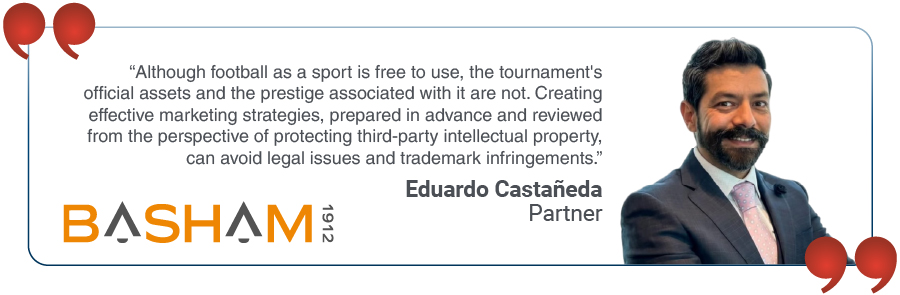
In this Mexico Business News article, WSG member Eduardo Castañeda, Partner at Basham, Ringe y Correa, discusses the legal risks associated with ambush marketing at major international sporting events. He explains how organizations are strengthening protections for sponsors and event-related intellectual property, creating heightened compliance considerations for businesses seeking to leverage the visibility of these events. Given FIFA's extensive protections over trademarks, logos, slogans, mascots, and other event-related assets, he emphasizes the importance of carefully structuring marketing campaigns to avoid creating the impression of an unauthorized association with the tournament.
Read More
56f9fa9a-3e45-4572-859c-334bf11a6681|0|.0|27604f05-86ad-47ef-9e05-950bb762570c
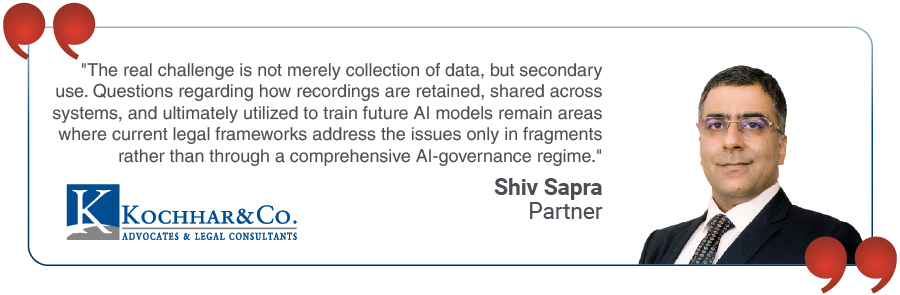
In this Economic Times Legal article, WSG member Shiv Sapra, Partner at Kochhar & Co., discusses the privacy and legal concerns surrounding the use of in-home service recordings to train artificial intelligence systems. She notes that while privacy laws address certain aspects of data collection, the rapid advancement of AI continues to expose regulatory gaps, highlighting the need for transparent data practices and careful evaluation of evolving privacy and compliance obligations.
Read More
94cacd0e-d10c-4c84-8da5-ce0b550f2123|0|.0|27604f05-86ad-47ef-9e05-950bb762570c